WWF | Species index | Regions index
Philatelic of Birds | 小菜鳥的博客 (Chinese version 中文版) Blogspot | C6 Club

18 February 2011

Birds of Macedonia

From left to right :
Eastern Imperial Eagle (白肩鵰) ; Eurasian Hoopoe (戴勝)
Little Egret (小白鷺) ; Glossy Ibis (白頭䴉鸛) ; Purple Heron (紫鷺)
Grey Heron (蒼鷺)
Macedonia (2001, 2008, 2000)

25th December, 2010. Gjorche Petrov

After couple of days, I got a mail from former Yugoslavia country again ; it is the forth after Slovenia, Croatia and Serbia. Thanks Ana of this cover and selected variety issues from different period, included two WWF issues : Eastern Imperial Eagle originally to be found in south-east of Europe, west and middle Asian countries. As the inhabit loss, population was decreasing and now it is rarely to find them in Hungary and Pannonian Basin. Hoopoe originally is a common bird, however also the inhabit loss, population in south-east Europe is decreasing and endanger in Macedonia and nearby countries.

Herons and Egrets are common birds in the Europe and Asia, they are popular and famous to bird-watchers.

5 February 2011

Marine life of Indonesia

From left to right bottom :
Olive Ridley Turtle (麗龜) ; Green Sea Turtle (綠蠵龜)
Leatherback Turtle (棱皮龜) ; Indo-Pacific Hawksbill Turtle (太平洋玳瑁)
Indonesia (2010)

24th October, 2010. Jakarta
19th November, 2010. Semarang, Tanah Mas
30th November, 2010. Hongkong


Unfortunately, in the time of writing, the WWF International and Groth AG, the agency approves philatelic products with WWF Panda logo. Did not authorize post office of Indonesia issue above stamp set with their logo. It was sadly to see this situation as the beautiful stamps couldn't be a part of WWF series. 4 stamps illustrate variety turtle species with description as above. Those four turtles, now facing over-hunting, egg stolen or population of ocean etc. different poor situations, the population decrease quickly in recent years.

1 January 2011

Siberian Crane

Siberian Crane (西伯利亞白鶴)
Iran (2007)
1st August, 2010. Tehran (Philatelic Bureau)

Siberian Crane, as known as Snow Crane mostly to be found in Far East region of Russia, breeds in Sakha Republic and Siberia while migrates to Fereidoonkenar and Isfahan of Iran ; Keoladeo National Park of India and south of Yangtze River of China for winter. It almost in white and brown but with blackish long bill, about 140cm tall and can be near 10kg weight. The population decreased quickly with unknown reasons in recent years, but scientist thought that construction of Three Gorges Dam in China is one reason caused they lost habitat.

This year is 50th anniversary of World Wide Fund of Natural. To celebrate this event, many countries and areas planned to issue stamps feature related foundation people and endangered species, until now confirmed Swiss, Great Britain and Macao issue the theme during 2011.

25 September 2010

Cobb's Wern

Cobb's Wern (科氏鷦鷯)
Falkland Islands (2009)
20th August, 2010. Stanley
31st August, 2010. Hongkong

Cobb's Wern, as known as Rock Wern in locals is a small brownish bird endemic to Falkland Islands, formally it was sub-species of House Wren (鶯鷦鷯), but it separated later as independence species. It mostly nesting Tussac Grass near the coast with hollow ball shape, which only to be found in South America and Falkland. The bird may breeds three to four eggs during October to December in each year. According to the small restricted area, under 2,000 pair recorded in recent years and being to be a endangered species.

7 August 2010

Piping Plover

Piping Plover (笛鴴)
Barbados (1999)

5th May, 2010. St Lucy
6th May, 2010. Bridgetown (Registration Branch, GPO)


Piping Plover is a small size plover as little as House Sparrow (麻雀), it looks sand colour ; the legs of adult plovers in orange colour, and also with black brand between two eyes. During the breeding period, birds will have one more ring in the neck. Piping Plover mostly breeding in the coast of Five-lake zone, Canada ; also the Atlantic coastlines of Canada and the United States. In winter, they will migrate to south as far as Gulf of Mexico and Caribbean islands.

Above WWF series stamp issued by Barbados on 1999 shown the plover's eggs, juvenile, males and females respectively. The background illustrated they mostly appear on the bank or waterfront. In Barbados, only few (not more than 100 populations) Piping Plover to be found in each year during migratory seasons, they mostly live in north and east side of the country. This cover, was sent from St Lucy post office where is the northernmost parish of Barbados.

17 June 2010

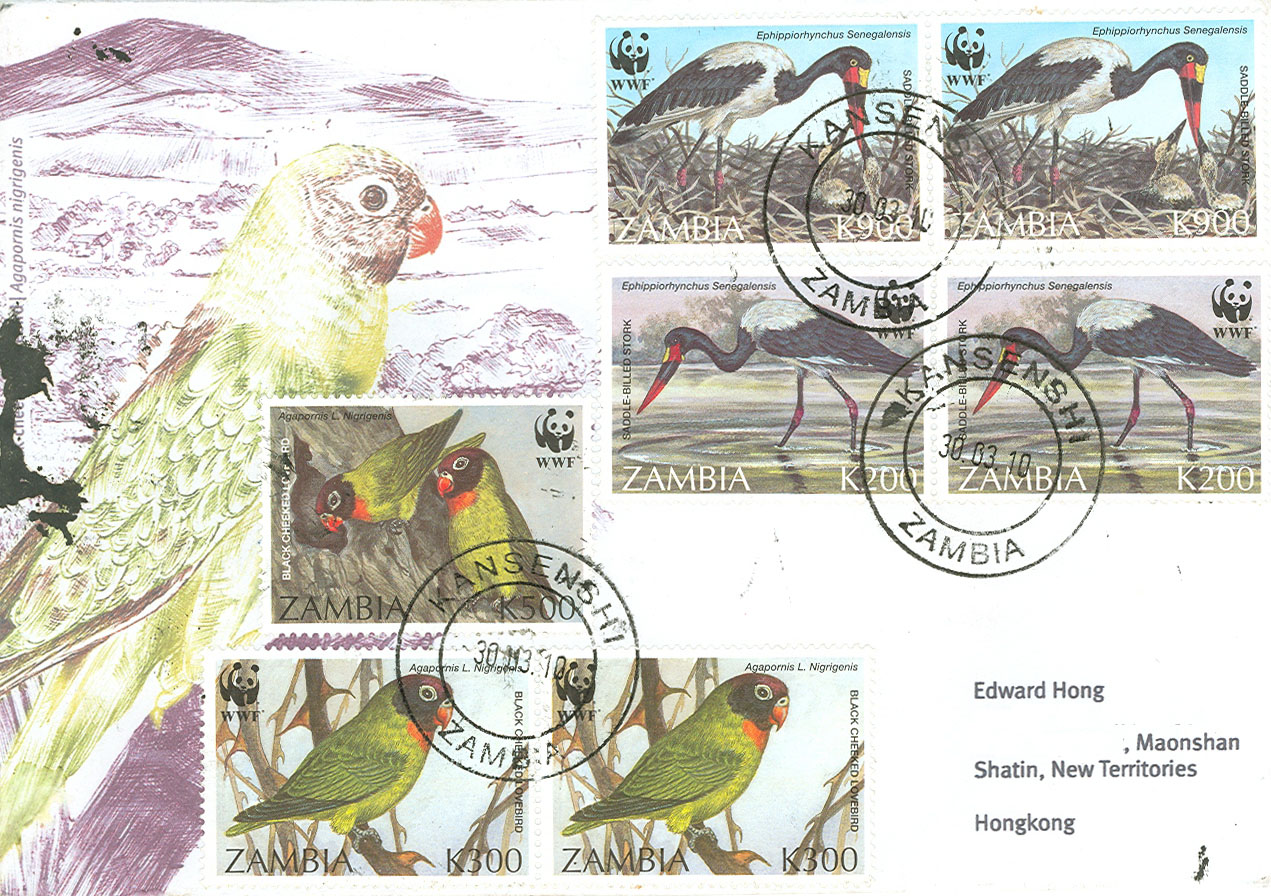
Saddle-bill Stork and Black-cheeked Lovebird

FrontK200 and K900 : Saddle-billed Stork (鞍嘴鸛)
K300 and K500 : Black-cheeked Lovebird (黑頰情侶鸚鵡)
Zambia (1996)

30th March, 2010. Kansenshi, Nodla
30th March, 2010. Nodla
31st March, 2010. Lusaka


Do you remember a cover from Malawi features a WWF stamp set of Nyasa Lovebird (尼亞情侶鸚鵡) ? It was a great and lovely stamp set in WWF series. Until now, only two stamp sets in WWF series are featuring species in Agapornis (情侶鸚鵡) genus, Malawi one is the second and the first one issued by Zambia on 1996 which shown as above. Above illustrated cover affixed whole set of stamps sent from Nodla, so you can find all two species in the stamp set. As well as last two Zambian mails, this cover be regraded by Mr. Ramsey, many thanks for his great help.

Saddle-billed Stork is a great stork widely to be found in sub-Saharan area, from Sudan to South Africa. Height 1,5m and the wings can be width 2,7m, except head, neck, back and tail in black colour ; black legs with pink knees, and huge reddish with black bar bill, it almost in white. The bird mostly lives in tropical marshes and wetlands, nesting in branch with deep and wide nest. Black-cheeked Lovebird is mainly in green with blackish head and reddish bill, it is endemic to Victoria Waterfall area of Zambia, as it habits in relatively small range area caused the bird easy be effected by habitat change, now it listed as vulnerable in ICUN list. Same as most lovebirds, it also is a popular pet over the world, in wild area it mostly inhabits woodland.

Above cover was sent from Kansenshi, where is a town in south-west of Nodla. Below is the back side of above envelope demonstrated how the mail processing in Zambia. And also a maxicard features Black-cheeked Lovebird, thanks Andrew of Zambia and Yoram of London, who had exciting safari trip on late-May.

Back
MaxicardBlack-cheeked Lovebird (黑頰情侶鸚鵡)
Zambia (1996)

31st May, 2010. Nodla

10 April 2010

Black-faced Spoonbill, again

Black-faced Spoonbill (黑面琵鷺)
Korea, DPR of (2009)

21st January, 2010. Pyongyang

After a year, I would show again Black-faced Spoonbill here, this is the second post about this endangered species. The last post, shown together with an envelope from Hongkong to Vandas Nova of Portugal and a prepaid envelope sent from Chigo of Taiwan. In 2009, North Korea was issued a series of stamps and products illustrate Black-faced Spoonbill, and also they are one of series of WWF theme. Above aerogramme is the example of the series.

Korea Peninsula and part of north-eastern China is the breeding places of Black-faced Spoonbill, and they will migrate to south for winter. Mostly they stay in south of Taiwan, south-east China especially Hongkong and farther south to Vietnam. As the change of inhabit places, population has been decreased in 80's years of last century. After large range of conversation, quantity is increasing back in these few years.