WWF | Species index | Regions index
Philatelic of Birds | 小菜鳥的博客 (Chinese version 中文版) Blogspot | C6 Club
Showing posts with label Europe. Show all posts

7 January 2017

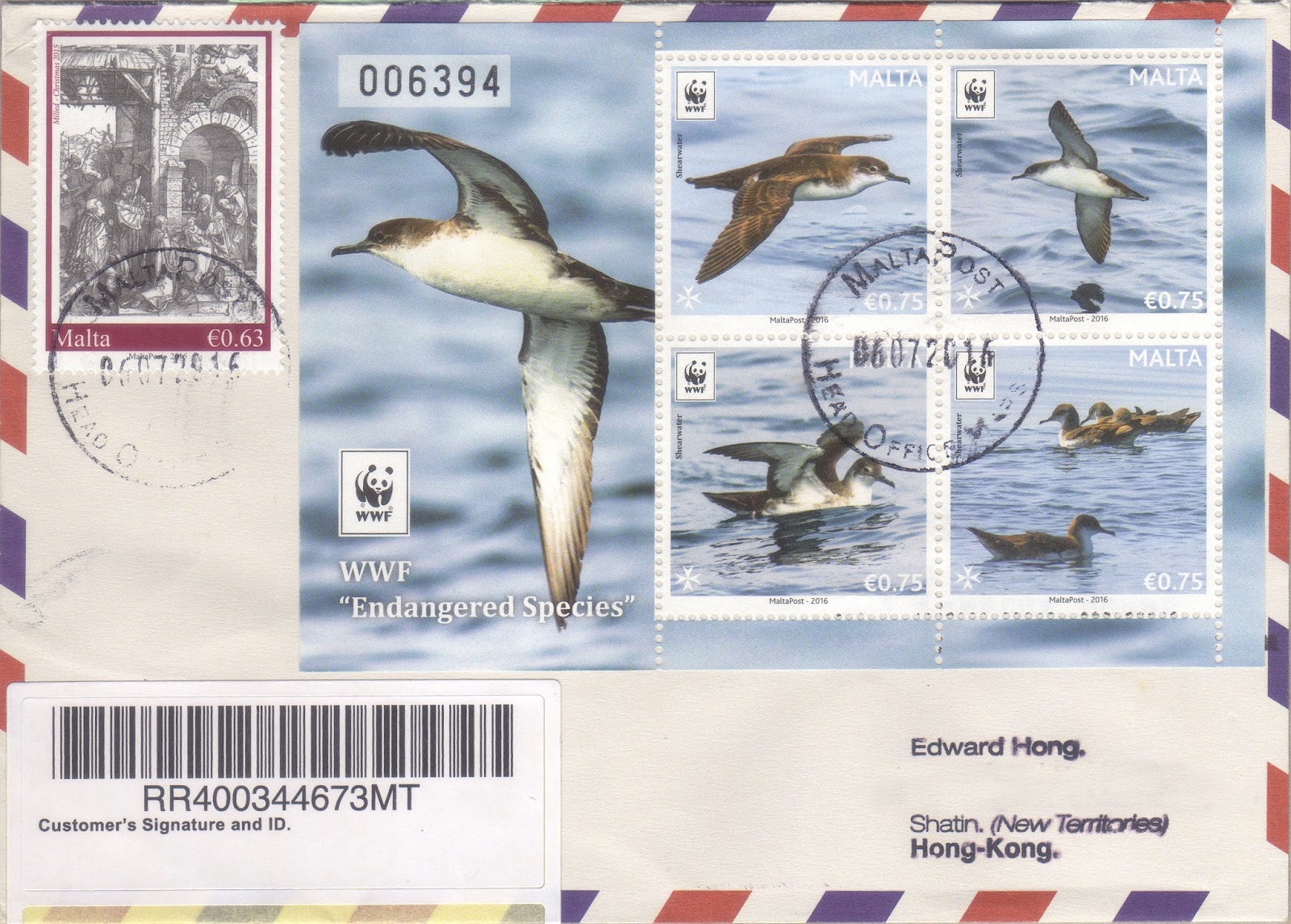
Levantine Shearwater

Levantine Shearwater (地中海海鸌)
Malta (1993, 2001)

6th July, 2011. Marsa

Shearwaters, which range from 35 to 65cm in length, nest in burrows on offshore islands and coastal hills in the North Atlantic, eastern South Atlantic, the Pacific and throughout the Mediterranean. These birds feed on fish, squid and other marine creatures while searing out at sea. Large flocks of Shearwaters are commonly seen between March and November, scavenging behind trawlers together with other sea birds. The Shearwater has a very particular call, similar to a crying baby.

This bird breeds in colonies on rocky islands and cliffs, using cavities and burrows. They are frequent breeders and their eggs hatch within 53 days. The largest colony in the Maltese Islands is found at Ta' Cenc cliffs while some pairs also breed on Comino as well as on the Fungus Rock at Dwejra Bay, Gozo.

31 May 2014

Short-toed Eagle

Short-toed Eagle (短趾雕)
Azerbaijan (2011)
3rd April, 2014. Baku

This is an Old World species spread throughout the Mediterranean basin and into Russia and the Middle East, and into parts of Asia, mainly in the Indian Subcontinent and also further east in some Indonesian islands.

Those present on the northern edge of the Mediterranean and other parts of Europe migrate mainly to sub-Saharan Africa north of the equator, leaving in September/ October and returning in April/ May. In the Middle and Far East the populations are resident. In Europe it is most numerous in Spain where it is fairly common but elsewhere it is rare in many parts of its range. A bird on the Isles of Scilly, Britain, in October 1999 was the first confirmed record for that country.

The Short-toed Snake Eagle is found in open cultivated plains, arid stony deciduous scrub areas and foothills and semi-desert areas. It requires trees for nesting.

19 May 2013

Loons and grebes

From left to right :
Red-throated Loon (紅喉潛鳥) ; Horned Grebe (角鸊鷈)
Great Crested Grebe (鳳頭鸊鷉) ; Black-throated Loon (黑喉潛鳥)

Åland (2013)
5th April, 2013. Mariehamn

After many years, Åland issued new WWF stamps again, this time feature 4 loons and grebes commonly to be found in this small islands. I decided order a FDC from the philatelic bureau, but sadly the shame Hongkong Post once again damaged this beautiful (and quite expensive) FDC.

8 December 2011

50th anniversay of WWF

From top of first column to bottom of last column :
Eurasian Hobby (燕隼) ; Eurasian Wryneck (蟻鴷) ; Red-backed Shrike (紅背伯勞)
Golden Oriole (金黃鸝) ; Redstart (紅尾鴝)
Eurasian Pygmy Owl (花頭鵂鶹) ; Nightingale (夜鶯) ; Whinchat (草原石即鳥)
Liechtenstein (2011)
9th September, 2011. Vaduz

To commemorate the 50th anniversary of foundation of WWF, couple of countries issued stamps last year. The most interesting stamps possible is Liechtenstein, which is a souvenir sheet features 8 species in Europe, from songbirds to preys of bird. Although the stamp shame in hexagonal shape, overall it looks nice as the birds look inhabit in the forest. The most special is the sheet features 8 variety species while compare to other WWF series maximum in four.

However, they are all very common to be found in European countries, it was quite oddly to the license holder wish endangered species appear on the stamps. Perhaps it changes its mind but it is not good for collector as the series will be overflowed.

Maxicard

From top to bottom :
Red-backed Shrike (紅背伯勞) ; Redstart (紅尾鴝)
Eurasian Wryneck (蟻鴷) ; Whinchat (草原石即鳥)
Nightingale (夜鶯) ; Golden Oriole (金黃鸝)
Liechtenstein (2011)
9th September, 2011. Vaduz

11 September 2011

Hyacinth Macaw, and other species in Amazon forest

Hyacinth Macaw (紫藍金剛鸚鵡)
Great Britain (2011)

22nd March, 2011. Trafalgar Square, London

Hyacinth Macaw is the largest species of Psittaciformes (鸚形目), which has unique body, charmed jewelery blued feather are attracted to pet feeder. The macaw is endemic to Amazon tropical palm forests or swamps of southern Brazil, east of Bolivia and north of Paraguay. As it is a popular pet of people, the macaw has big demand in pet market and caused wild macaws are being illegal bird trading. Moreover according to the over development of forest area, their inhabit area are damaged or lost. In 80's year over 10,000 birds be caught and most of them traded to black-market of Brazil, now only 3,000 wild macaws to be found in this area.

The stamp as above comes from souvenir sheet of Great Britain, which commemorated 50th anniversary of Worldwide Fund of Nature. Whole set products include 10 stamps with worldwide endangered mammals and souvenir sheet as below features 4 species to be found in Amazon forest. But disappointingly none of them related to Great Britain.

Today is a big day as it was a foundation day of Worldwide Fund for Nature in 50 years ago. The orginasation registered at Morges, Switzerland on 11th September by Sir Julian Huxley who is a British biologist.

Clockwise from top :
1st class : Red-faced Spider Monkey (朱顏蜘蛛猴) ; 60p : Hyacinth Macaw (紫藍金剛鸚鵡)
88p : Brazilian Cobalt Dart Frog (巴西鈷藍箭毒蛙) ; 97p : Jaguar (美洲豹)
Great Britain (2011)

22nd March, 2011. Trafalgar Square, London

26 June 2011

Pygmy Cormorant

Pygmy Cormorant (侏鸕鶿)
Serbia (2011)

24th May, 2011. Kanjiža

It is the third set of WWF series in 2011 I collected. Not much special but seem nice enough, it features Pygmy Cormorant. This species breeds in southeastern Europe and southwestern Asia, and it partially migrate to further south for winter. Due to the drainage, inhabit lose, pollution and illegal hunting, the population of Pygmy Cormorant is decreasing and now be listed as near threatened in IUCN list.

29 April 2011

50 years on, the World Wide Fund for Nature (WWF)

Clockwise from top-left :
Barnacle Goose (白頰黑雁) ; Black Scoter (黑海番鴨)
Gadwall (赤膀鴨)
Iceland (2011)

27th January, 2011. Reykjavik (first day special postmark)

In 1960, Sir Julian Huxley (22 June 1887 – 14 February 1975), a British biologist wrote a couple of articles related to his observation for newspaper after his East African trip. Huxley received number of feedback on his concerned, one of feedback from Victor Stolan suggested him found an organisation for further conservation. Huxley accepted his suggestion but Stolan did not join the occurrence. Later on, Huxley together with Max Nicholson and Peter Scott produced a document Morges Manifesto, a foundation document of World Wildlife Fund for Nature and signed on 29 April of 1961. It was a beginning of WWF and its organisation registered at Morges, Switzerland on 11th September, 1961. 50 years on, WWF founding and controlling variety conservation areas and supporting different environment events over the world. Today, is a day to celebrate 50th anniversary of the foundation of WWF.

More than 20 countries to be issued stamps to commemorate this event. Guinea-Bissau and Iceland two of the firsts two issued on January, Iceland one features four waterbirds commonly to be found in Europe. Nevertheless, those four species are endangered in Iceland, they are wholly be protected in this island country.

Maxicard
White-fronted Goose (白額雁)
Iceland (2011)

27th January, 2011. Reykjavik (first day special postmark)

18 February 2011

Birds of Macedonia

From left to right :
Eastern Imperial Eagle (白肩鵰) ; Eurasian Hoopoe (戴勝)
Little Egret (小白鷺) ; Glossy Ibis (白頭䴉鸛) ; Purple Heron (紫鷺)
Grey Heron (蒼鷺)
Macedonia (2001, 2008, 2000)

25th December, 2010. Gjorche Petrov

After couple of days, I got a mail from former Yugoslavia country again ; it is the forth after Slovenia, Croatia and Serbia. Thanks Ana of this cover and selected variety issues from different period, included two WWF issues : Eastern Imperial Eagle originally to be found in south-east of Europe, west and middle Asian countries. As the inhabit loss, population was decreasing and now it is rarely to find them in Hungary and Pannonian Basin. Hoopoe originally is a common bird, however also the inhabit loss, population in south-east Europe is decreasing and endanger in Macedonia and nearby countries.

Herons and Egrets are common birds in the Europe and Asia, they are popular and famous to bird-watchers.

7 April 2010

Spotted Flycatcher

Spotted Flycatcher (斑鶲)
Isle of Man (2000)
26th January, 2010. Douglas

After two years, another request mail from Isle of Man Philatelic Bureau. Same as last mail, another stamp which comes from same WWF issue has been used, the only different is this is maxicard. The card specially printed in black and white colour shown the bird standing on the dead branch. Spotted Flycatcher is very common in Europe and also western Asia as there is breeding place of them. In winter, it migrates to Africa and south-west Asia.

16 November 2009

Eastern White Pelican

Eastern White Pelican (白鵜鶘)
Ukraine (2007)

12th October, 2009. Kiev

Thank you Philipp of this mail from Kiev, actually this stamp set I waited for a long time and wanted to do it during stamp exhibition, however the Ukraine sale booth sold the stamps in HK$50, it was quite unreasonable as dealer only sells it in cheap price. The mail so pity that cancelled by machine postmark, it seems too heavy and two stamps couldn't been cancel.

Eastern White Pelican is one of large pelicans in the world, it breeds in south-east European countries and have short migration to southern Africa or south-west Asia for winter. This species is not endanger species but as more than 50% pelicans breed in the Danube Delta, where is an important breeding place of the pelicans in Romania and Ukraine. Especially only approximate 706km² of left bank of the Chilia area is situated in Ukraine, Eastern White Pelicans seem is a small settlement in this country.

4 August 2009

Red Kite in southern Europe

Red Kite (紅鳶)
Gibraltar (1996)

25th June, 2009. Gibraltar
15th July, 2009. Hongkong


It is the third time to show Red Kite stamp in here, last two are Great Britain and Switzerland separately. In last post says that Red Kite is very common in continent of Europe, however in western and southern of Europe, especially along the seashore of the Mediterranean, it is rarely to find its appearance. In winter, there are small number of Red Kites fly over Gibraltar when they migrating from northern Europe to North Africa, this WWF issue illustrated the birds bleed and live around the fort at the top of Rock of Gibraltar.

On the back of this cover franked with one extra stamp Honey Buzzard (鳳頭蜂鷹), it is one of newest Gibraltar definitive stamps but will not show in here.

17 March 2009

Field birds in British Isles

Here I would present three items came from British Isles but they were sent from three different places respectively. Those birds shown below are very common on the islands, either in field, gardens or bank of rivers. They are small, can sing nice songs and pleasant.

Great Britain

Maxicard
Song Thrush (歐歌鶇)
Great Britain (1998)
10th June, 2008. Chelmsford, Essex

A popular garden songbird can be found in farmland and most of gardens, however the populations in England are decreasing in recent years, now it is Red Listed species. In England, there are about one million residents recorded. The cancellation of the maxicard is date-postmark of Chelmsford, a city in the east of England. There have a wetland in the town centre and most bird-watchers obverse the birds in there.

Ireland

Left : Goldcrest (戴菊) ; Right : Common Blackbird (烏鶇)
Ireland (2002)
29th April, 2008. Dublin

Goldcrest is the smallest bird in isles, mostly can be found them in coniferous forests and woodlands, also suburban area and gardens. A resident in most area through whole the year but during summer in north Scotland. Common Blackbird is the most common in field and gardens. As named as blackbird, overall its feather are black but with yellowed bill. Above cover franked with three definitive stamps, birds were issued on 2002 and wildflower was issued on 2006, which for replaces bird issue. 10c is illustrated the Mountain Avens (仙女木), a Wild Flower common to the Burren.

Isle of Man

Barn Swallow (家燕)
Isle of Man (2000)
25th April, 2008. Douglas

Barn Seallow is very common in the world, which likes nesting under eaves. Can be found them where have worms or small insects, lives in northern area but widely seen them in summer. Isle of Man is in the middle of Britain and Ireland, a part of Crown dependency of Great Britain.

3 March 2009

Steller's Eider

Front
Steller's Eider (小絨鴨)
Åland (2001)

Back
Arctic Tern (北極燕鷗)
Åland (2000)
16th February, 2009. Mariehamn

Before I only collect bird stamps, issues from some countries are very attractive for me and continue to collect them, Åland is one of them. It doesn't issue many stamps in each year, just around 20 to 25 stamps, and they are not costly. However, it is not easy to find posted envelope from there - if not visit or travel to there.

Above mail, thanks for correspondence of Åland Post, helped me coordinate the cover. As the registered label too large for C6 size envelope, they found a plastic bag put all things together. I franked it on the back side of envelope after it arrived.

Steller's Eider is a rear migratory bird found in northern countries. As seen in the stamps, male feather is much colourful than female which only have browned colour. They bleeding in small pound but live in near shore. On the back side of the cover features another bird called Arctic Tern, it has been appeared on Portugal stamp and shown here before.

Dear swap partners, as some reasons, swap posted First Day Cover activity will be suspended on May, that means I will not have ability to send you posted First Day Cover in future, I am sorry for this information. However normal exchange will not have any change, I am happy to swap ordinary covers from your place, thank you.

28 February 2009

Extended WWF collection (2)

Left : Common Viper (極北蝰) ; Right : Fire Salamander (火蠑螈)
Belgium (2000)
21st January, 2009. Mechelen

A pair of envelope contain a set of WWF stamps issued by Belgium on nine years ago, stamps are illustrated four european Amphibians (兩棲類) and Reptiles (爬蟲類) separately. Stamps designed simply without any background, as it issued on 2000, face values are indicated in two currencies - Belgian Franc and Euro.

Fire Salamander and Sand Lizard are being popular pets nowadays, although whole skin of Fire Salamander is poisonous. Many websites teach people how to pet those species at home or bleeding juvenile. As like as most species, wild lived habitants are decreasing in recent years, especially in Europe.

Covers feature extra Buzin stamps issued on 2005, it is Marsh Tit (泥澤山雀). It is very common in Europe except Spain and Portugal, and can be found in forest of north-east China. In China, it is traditional pet as they can sing a nice sound, thus they are facing illegal hunting and trading in its place for a long time.

Left : Sand Lizard (捷蜥蜴) ; Right : Common Tree Frog (歐洲樹蟾)
Belgium (2000)
21st January, 2009. Mechelen

21 February 2009

Little Tern

Front
Little Tern (小燕鷗)
Croatia (2006)

Back
Orsini's Viper (歐西尼氏腹蛇)
Croatia (1999)
10th February, 2009. Zagreb
16th February, 2009. Hongkong

An interesting cover features two different WWF stamp sets issued by Croatia. The country has been issued three sets of WWF stamp, I still missing the one issued on 2004. Little Tern seems is a normal seabird in the world, can be found offshore of Asia, Europe, eastern Australia and western Africa. However the population has declined or become extinct in most European countries, and only few river or inland suitable for them to habitat. In Croatia, Sava and Drava, which is located in the border of Hungary and Croatia can be found the habitations.

5 February 2009

European Turtle Dove

European Turtle Dove (歐斑鳩)
Madeira (2002)
25th February, 2008. São Vicente, Madeira

A small (27mm) chalk-browned Turtle Dove with black and white veins on neck and dark-browned wings, size is smaller than Rufous Turtle Dove. Mostly they are widely living in Europe, Eurasia and North Africa. In Madeira, good bird-watching place is São Vicente, a small village in the north of Madeira.

Above cover is sent from São Vicente, the return address I added back after it come back. However, I known one friend who lives in Madeira afterward, her house is in São Vicente and nearest this hotel. She surprises this cover and sent me some postcards from there, it is really a nice place.

6 January 2009

European Roller

European Roller (藍胸佛法僧)
Lithuania (2008)
8th September, 2008. Vilnius (First day special postmark)
6th October, 2008. Vilnius
11th October, 2008. Hongkong

A very common and large globe population bird in the old days, which can be found from Eurasia to North Africa, estimated 100,000 pair recorded in Europe. However the amount decreasing largely in following years, nowadays only 30 pairs can be observed in Latvia and Lithuania and no record of Estonia and Central Asia. The conservation states now is near threatened. This first day cover sent after a month of issue day, beside these 4 nice European Rollers, two bird stamps franked on the back side, which they are Great Snipe (巨鷸) and Corn Crake (長腳秧雞) separately.

21 December 2008

Black Stork

Black Stork (黑鸛)
Belarus (2005)
17th February, 2008. Minsk
28th February, 2008. Hongkong

It is quite common migratory bird in Europe and Far East Asia, and some habitant in southern Africa. In Hongkong, winter is good season to find them in Maipo wetland. But as many different reasons, Black Stork becomes rare in northern Europe, the amount of them are decreasing. Stamps on this envelope is a whole set issued on 2005, and also franked with other bird definitive stamps which are other species. Thanks to Alexander Rusak for the great help.