WWF | Species index | Regions index
Philatelic of Birds | 小菜鳥的博客 (Chinese version 中文版) Blogspot | C6 Club
Showing posts with label Maxicard. Show all posts

15 September 2013

Black Crowned-crane

Black Crowned-crane (黑冠鶴)
The Gambia (2006)

7th July, 2013. Banjul

Black Crowned-crane is a bird in the crane family Gruidae. It occurs in dry savannah in Africa south of the Sahara, although in nests in somewhat wetter habitats. This species and the closely related Grey Crowned-crane (東非冕鶴), which prefers wetter habitats for foraging, are the only cranes that can nest in trees. Like all cranes, Black Crowned-crane eats insects, reptiles, and small mammals. It is endangered, especially in the west, by habitat loss and degradation.

Black Crowned-crane (黑冠鶴)
The Gambia (2006)

27th February, 2006. Banjul

8 December 2011

50th anniversay of WWF

From top of first column to bottom of last column :
Eurasian Hobby (燕隼) ; Eurasian Wryneck (蟻鴷) ; Red-backed Shrike (紅背伯勞)
Golden Oriole (金黃鸝) ; Redstart (紅尾鴝)
Eurasian Pygmy Owl (花頭鵂鶹) ; Nightingale (夜鶯) ; Whinchat (草原石即鳥)
Liechtenstein (2011)
9th September, 2011. Vaduz

To commemorate the 50th anniversary of foundation of WWF, couple of countries issued stamps last year. The most interesting stamps possible is Liechtenstein, which is a souvenir sheet features 8 species in Europe, from songbirds to preys of bird. Although the stamp shame in hexagonal shape, overall it looks nice as the birds look inhabit in the forest. The most special is the sheet features 8 variety species while compare to other WWF series maximum in four.

However, they are all very common to be found in European countries, it was quite oddly to the license holder wish endangered species appear on the stamps. Perhaps it changes its mind but it is not good for collector as the series will be overflowed.

Maxicard

From top to bottom :
Red-backed Shrike (紅背伯勞) ; Redstart (紅尾鴝)
Eurasian Wryneck (蟻鴷) ; Whinchat (草原石即鳥)
Nightingale (夜鶯) ; Golden Oriole (金黃鸝)
Liechtenstein (2011)
9th September, 2011. Vaduz

29 April 2011

50 years on, the World Wide Fund for Nature (WWF)

Clockwise from top-left :
Barnacle Goose (白頰黑雁) ; Black Scoter (黑海番鴨)
Gadwall (赤膀鴨)
Iceland (2011)

27th January, 2011. Reykjavik (first day special postmark)

In 1960, Sir Julian Huxley (22 June 1887 – 14 February 1975), a British biologist wrote a couple of articles related to his observation for newspaper after his East African trip. Huxley received number of feedback on his concerned, one of feedback from Victor Stolan suggested him found an organisation for further conservation. Huxley accepted his suggestion but Stolan did not join the occurrence. Later on, Huxley together with Max Nicholson and Peter Scott produced a document Morges Manifesto, a foundation document of World Wildlife Fund for Nature and signed on 29 April of 1961. It was a beginning of WWF and its organisation registered at Morges, Switzerland on 11th September, 1961. 50 years on, WWF founding and controlling variety conservation areas and supporting different environment events over the world. Today, is a day to celebrate 50th anniversary of the foundation of WWF.

More than 20 countries to be issued stamps to commemorate this event. Guinea-Bissau and Iceland two of the firsts two issued on January, Iceland one features four waterbirds commonly to be found in Europe. Nevertheless, those four species are endangered in Iceland, they are wholly be protected in this island country.

Maxicard
White-fronted Goose (白額雁)
Iceland (2011)

27th January, 2011. Reykjavik (first day special postmark)

17 June 2010

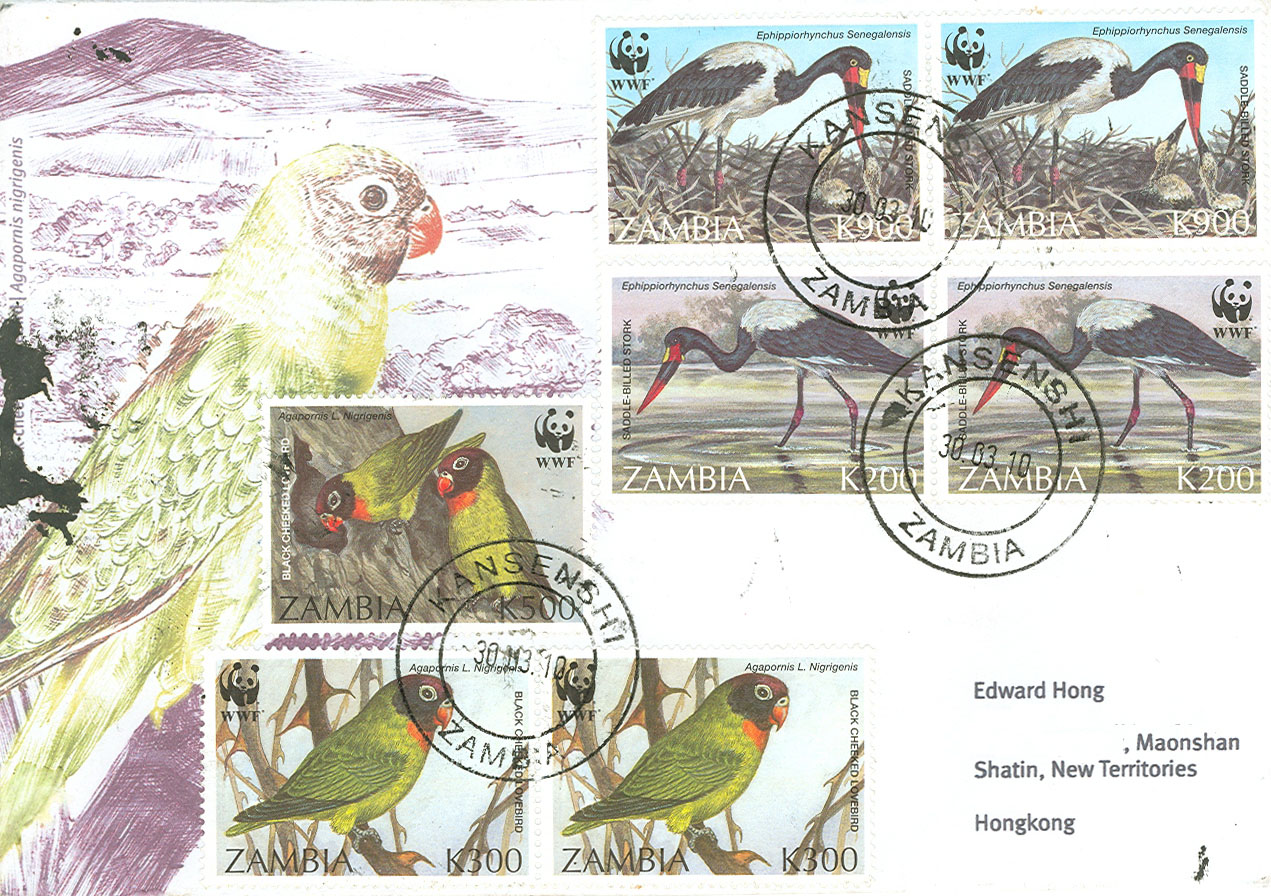
Saddle-bill Stork and Black-cheeked Lovebird

FrontK200 and K900 : Saddle-billed Stork (鞍嘴鸛)
K300 and K500 : Black-cheeked Lovebird (黑頰情侶鸚鵡)
Zambia (1996)

30th March, 2010. Kansenshi, Nodla
30th March, 2010. Nodla
31st March, 2010. Lusaka


Do you remember a cover from Malawi features a WWF stamp set of Nyasa Lovebird (尼亞情侶鸚鵡) ? It was a great and lovely stamp set in WWF series. Until now, only two stamp sets in WWF series are featuring species in Agapornis (情侶鸚鵡) genus, Malawi one is the second and the first one issued by Zambia on 1996 which shown as above. Above illustrated cover affixed whole set of stamps sent from Nodla, so you can find all two species in the stamp set. As well as last two Zambian mails, this cover be regraded by Mr. Ramsey, many thanks for his great help.

Saddle-billed Stork is a great stork widely to be found in sub-Saharan area, from Sudan to South Africa. Height 1,5m and the wings can be width 2,7m, except head, neck, back and tail in black colour ; black legs with pink knees, and huge reddish with black bar bill, it almost in white. The bird mostly lives in tropical marshes and wetlands, nesting in branch with deep and wide nest. Black-cheeked Lovebird is mainly in green with blackish head and reddish bill, it is endemic to Victoria Waterfall area of Zambia, as it habits in relatively small range area caused the bird easy be effected by habitat change, now it listed as vulnerable in ICUN list. Same as most lovebirds, it also is a popular pet over the world, in wild area it mostly inhabits woodland.

Above cover was sent from Kansenshi, where is a town in south-west of Nodla. Below is the back side of above envelope demonstrated how the mail processing in Zambia. And also a maxicard features Black-cheeked Lovebird, thanks Andrew of Zambia and Yoram of London, who had exciting safari trip on late-May.

Back
MaxicardBlack-cheeked Lovebird (黑頰情侶鸚鵡)
Zambia (1996)

31st May, 2010. Nodla

7 April 2010

Spotted Flycatcher

Spotted Flycatcher (斑鶲)
Isle of Man (2000)
26th January, 2010. Douglas

After two years, another request mail from Isle of Man Philatelic Bureau. Same as last mail, another stamp which comes from same WWF issue has been used, the only different is this is maxicard. The card specially printed in black and white colour shown the bird standing on the dead branch. Spotted Flycatcher is very common in Europe and also western Asia as there is breeding place of them. In winter, it migrates to Africa and south-west Asia.

17 March 2009

Field birds in British Isles

Here I would present three items came from British Isles but they were sent from three different places respectively. Those birds shown below are very common on the islands, either in field, gardens or bank of rivers. They are small, can sing nice songs and pleasant.

Great Britain

Maxicard
Song Thrush (歐歌鶇)
Great Britain (1998)
10th June, 2008. Chelmsford, Essex

A popular garden songbird can be found in farmland and most of gardens, however the populations in England are decreasing in recent years, now it is Red Listed species. In England, there are about one million residents recorded. The cancellation of the maxicard is date-postmark of Chelmsford, a city in the east of England. There have a wetland in the town centre and most bird-watchers obverse the birds in there.

Ireland

Left : Goldcrest (戴菊) ; Right : Common Blackbird (烏鶇)
Ireland (2002)
29th April, 2008. Dublin

Goldcrest is the smallest bird in isles, mostly can be found them in coniferous forests and woodlands, also suburban area and gardens. A resident in most area through whole the year but during summer in north Scotland. Common Blackbird is the most common in field and gardens. As named as blackbird, overall its feather are black but with yellowed bill. Above cover franked with three definitive stamps, birds were issued on 2002 and wildflower was issued on 2006, which for replaces bird issue. 10c is illustrated the Mountain Avens (仙女木), a Wild Flower common to the Burren.

Isle of Man

Barn Swallow (家燕)
Isle of Man (2000)
25th April, 2008. Douglas

Barn Seallow is very common in the world, which likes nesting under eaves. Can be found them where have worms or small insects, lives in northern area but widely seen them in summer. Isle of Man is in the middle of Britain and Ireland, a part of Crown dependency of Great Britain.