WWF | Species index | Regions index
Philatelic of Birds | 小菜鳥的博客 (Chinese version 中文版) Blogspot | C6 Club
Showing posts with label Oceania and Antarctica. Show all posts

4 March 2017

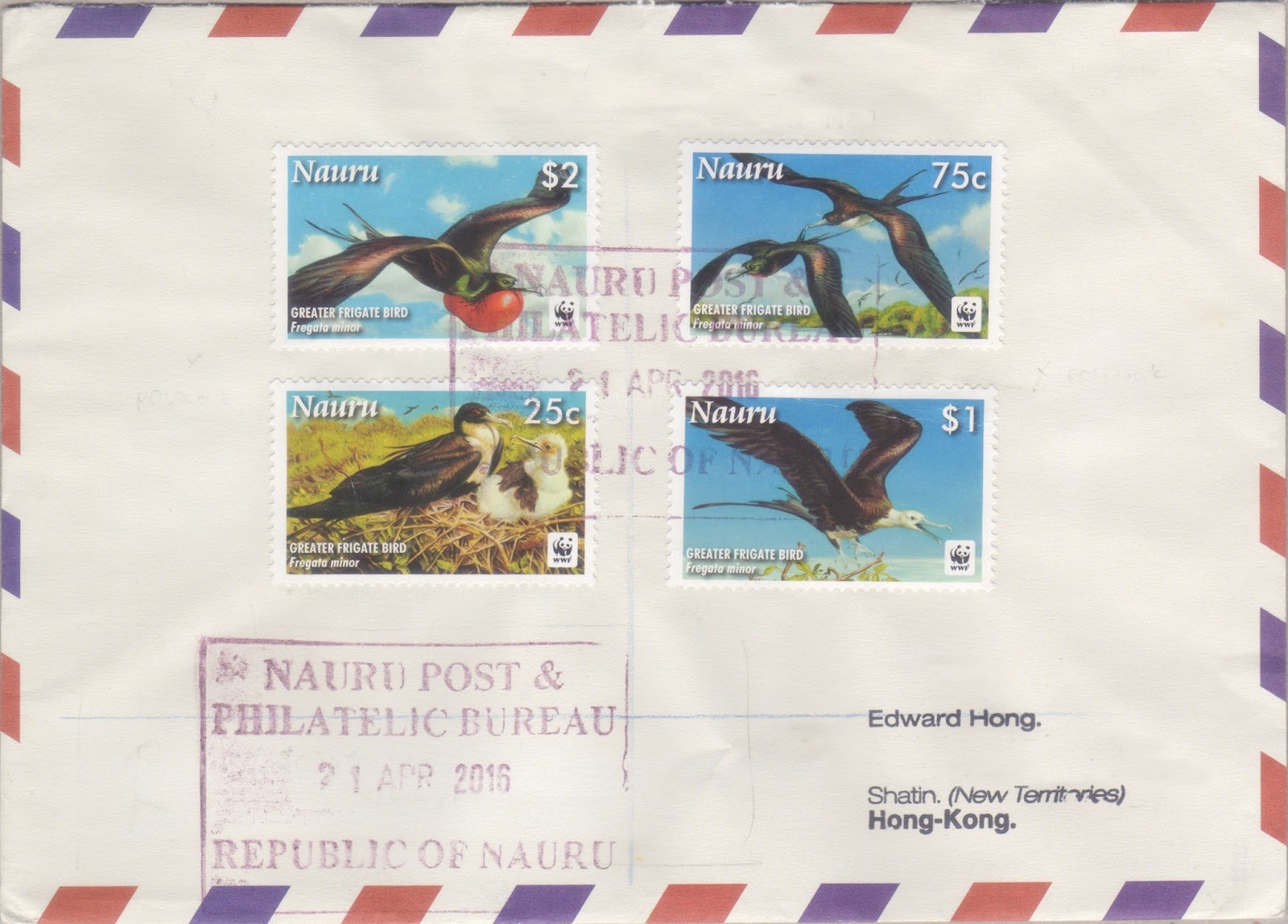
Great Frigatebird

Great Frigatebird (小軍艦鳥)
Nauru (2008)

21st April, 2016. Nauru

Great Frigatebird is a large seabird in the frigatebird family. Major nesting populations are found in the Pacific (including the Galapagos Islands) and Indian Oceans, as well as a population in the South Atlantic.

It is a lightly built, large seabird up to 105cm long with predominantly black plumage. The species exhibits sexual dimorphism; the female is larger than the adult male and has a white throat and breast, and the male's scapular feathers have a purple-green sheen. In the breeding season, the male is able to distend its striking red gular sac. The species feeds on fish taken in flight from the ocean's surface (mostly flying fish), and indulges in kleptoparasitism less frequently than other frigatebirds. They feed in pelagic waters within 80km of their breeding colony or roosting areas.

2 July 2016

Blue Coral

Blue Coral (藍珊瑚)
Tuvalu (1992)
26th March, 2016. Funafuti

Blue coral is a species of colonial coral and the only species in the family Helioporidae and the only Octocoral known to produce a massive skeleton. This skeleton is formed of aragonite, similar to that of scleractinia. Individual polyps live in tubes within the skeleton and are connected by a thin layer of tissue over the outside of the skeleton. It was described by Pallas in 1766.

 Despite being common in some areas and having a large range, the blue coral has been given the conservation status of a vulnerable species by the IUCN. Its population is unknown but it is believed to be decreasing in line with the global destruction of coral reefs; it is threatened by aquarium harversting, bleaching, habitat destruction, the acidification of oceans, and climate change. It is found in the eastern and western Indian ocean, and the eastern central, western central, northwestern, and southwestern Pacific Ocean; its range includes the Great Barrier Reef, Australia, Japan and the Ryukyu Islands. Its largest colony is believed to be located off Ishigaki Island in the Yaeyama Islands, southwestern Japan. It is found in reefs with depths below 2metres, or reefs exposed to waves, flats, intertidal regions, and sometimes in marginal habitats. The blue coral is listed under CITES Appendixes I and II.

30 April 2016

Harlequin Shrimp

 
Harlequin Shrimp (釉彩臘膜蝦)
Kiribati (2005)

2nd March, 2016. Tarawa

Harlequin Shrimp is a species of saltwater shrimp found at coral reefs in the tropical Indian and Pacific oceans. It is usually considered the only species in the genus Hymenocera, but some split it into two species: H. picta from the central and east Pacific where the spots are deep pinkish-purple with a yellow edge, and H. elegans from the Indian Ocean and west Pacific where the spots are more brownish and have a blue edge. They reach about 5 centimetres (2.0 in) in length, live in pairs and feed exclusively on starfish, including crown-of-thorns starfish. It does seem to prefer smaller, more sedentary starfish, but as these generally are not sufficiently numerous for its needs, it commonly will attack Acanthaster, both reducing its consumption of coral while under attack, and killing it within a few days.

11 October 2014

Blue Lorikeet

Blue Lorikeet (塔布吸蜜鸚鵡)
Aitutaki (2002)
16th July, 2014. Aitutaki

Blue lorikeet is a small lorikeet from French Polynesia and the Cook Islands. It is also known as the Tahiti lorikeet, violet lorikeet, Tahitian lory, blue lory, nunbird, and the indigo lory. It was formerly found on 23 islands around Tahiti, but now restricted to perhaps eight islands: Motu, Manuae, Tikehau, Rangiroa, Aratua, Kaukura, Apataki, Aitutaki, and possibly Harvey Island and Manihi. Its plumage is mainly dark blue and it has a white area over its upper chest, throat and face. The first captive breeding in the UK was by the Marquess of Tavistock in the 1930s. He was awarded a silver medal by the Foreign Bird League for this achievement.

9 December 2013

Tristan Albatross

Tristan Albatross (特島信天翁)
Tristan da Cunha (2013)
12th August, 2013. Tristan da Cunha

Tristan Albatross (Diomedea dabbenena) is a large seabird from the albatross family, which was only widely recognised as a full species in 1998. Due to the difficulty in distinguishing them from Wandering Albatrosses, their distribution at sea is still not fully known, but the use of satellite tracking has shown that they forage widely in the South Atlantic, with males foraging west of the breeding islands towards South America and females to the east towards Africa. There have been sightings near Brazil and also off the coast of Australia.

The Tristan Albatrosses are endemic to the islands of the Tristan da Cunha group and more specifically Gough Island. The majority of the world's population nest on Gough Island, around 1500 pairs. On some years a pair breeds on Inaccessible Island.

30 September 2013

Ducorps' Cockatoo

Ducorps' Cockatoo (杜氏鳳頭鸚鵡)
Solomon Islands (2013)
21st June, 2011. Honiara

The Ducorps' Cockatoo, also known as Solomons Corella or Broad-crested Corella, is a species of cockatoo endemic to the Solomon Islands. This small white cockatoo is larger than the Tanimbar Corella yet smaller than the Umbrella Cockatoo. The species is common across most of the Solomons, absent only from Makira in the south. It inhabits lowland rainforests, secondary forests, cleared areas and gardens. The Solomons Cockatoo nests in tree cavities. The eggs are white and there are usually two in a clutch. The eggs are incubated for about 25 days and the chicks leave the nest about 62 days after hatching.

The northern common cuscus, also known as the grey cuscus, is a species of marsupial in the Phalangeridae family native to northern New Guinea and adjacent smaller islands, but is now also found in the Bismarck Archipelago, south-east and central Moluccas, the Solomons and Timor, where it is believed to have been introduced in prehistoric times.

Two species are not endanger species but appear on the stamps.

Northern Common Cuscus (灰袋貂)
Solomon Islands (2002)

21 January 2013

WWF stamps again of South Georgia

From left to right :
70p : Antarctic Tern (南極燕鷗) ; 60p : South Georgia Shag (南喬治亞鸕鶿)
95p : Brown Skua (褐賊鷗) ; £1,10 : Kelp Gull (黑背鷗)

South Georgia and South Sandwich Islands (2012)
20th August, 2012. King Edward Point

In each few years, the South Georgia and South Sandwich Islands issues their WWF stamps, the above cover features the latest WWF stamp set issued on 2012, this is the first time features 4 species instead as before - 1 species for 4 stamps.

For species are common in sub-Antarctic ocean and islands - Antarctic Tern looks similar with Arctic Tern (北極燕鷗), however the wings of Antarctic Tern are in grey colour and only actives in Antarctic Ocean. South Georgia Shag is endemic to South Georgia and some sub-Antarctic Islands of South Atlantic Ocean. Brown Skua is a large seabird that breeds in the sub-Antarctic and Antarctic zones and moves further north when not breeding. Kelp Gull to be found in wide area of sub-Antarctic, southern Africa, South-America and Australia, include those offshore islands.

Below is the receipt of the registered mail, it shown that the post office still using traditional registration label in 2012.

13 October 2012

Collared Lory

Collared Lory (綠領吸蜜鸚鵡)
Fiji (2012)

11th July, 2012. Suva
20th July, 2012. Suva registration office

Actually I dislike nowadays WWF issues, as most of stamps set in high denomination. For example Liechtenstein on last year, whole set of the stamps are selling in 8 Swiss Franc, although they are beautiful and attractive. It seems discourage collector to buy more for their collection. In recent years, most of WWF stamps are sell in a sheetlet which contains 2 or 4 sets of stamps. That causes people will spend more in each issue and easily to be as fast as give up this hobby. This time, as well as last time, Fiji issued a attractive sheet includes 2 sets total value near 7 Euro. I still ordered a FDC and 2 sheets, the only reason is it related to parrot.

Collared Lory is an endemic species to Fiji, specially it can be found from forest to urban area, like Lau Island and Lakeba. The live of the parrot has been humanized to suitable urban situation, especially Suva, the capital of Fiji.

Collared Lory is not an endangered species, due to seem the organization agreed to approve more non-dangered species appear onthe stamps.

26 September 2011

Many-coloured Fruit-Dove again

Many-coloured Fruit-Dove (雜色果鳩)
Samoa (2011)
2nd September, 2011. Apia
10th September, 2011. Hong-Kong


I use 'again' in the topic, because the species had shown here already. A nice water-coloured Fiji fruit dove stamp set featured same bird on 2009. Now it comes to Samoa, be a part of collection of WWF series. Perhaps it coordinated by same stamp agency service, the design seems very similar to Vanuatu issue and the stamps are issued on same day.

Beside of Fiji, Many-coloured Fruit-dove also inhabit in Samoa. However as the islands are small enough, population of the dove in the islands are too small, the quantity closes endangered. But, of course, it overall is not endangered species in IUCN list.

1 September 2011

Massena's Lorikeet

Massena's Lorikeet (馬仙納氏吸蜜鸚鵡)
Vanuatu (2011)

23th August, 2011. Port Vila

After a year, Vanuatu Post issues again WWF series to commemorate 50th anniversary of the organisation, which found in 1951. This time features beautiful and attractive Massena's Lorikeet in strip of 4 format. The species not new to Vanuatu stamps but in first time to use illustration style to produce stamps.

Massena's Lorikeet is a sub-species of Rainbow Lorikeet (彩虹吸蜜鸚鵡), this complicate species has 21 sub-species which have different features and inhabit area. For Massena's Lorikeet, it endemic to Bismarck Archipelago of Papua New Guinea and Solomon Islands, and some of them rarely to Vanuatu, further south of its traditional inhabit area.

As above introduction, Massena's Lorikeet is not the first time shown on the stamps. Below aerogramme, issued couple of years features three Vanuatu domestic birds, one on the left side is Massena's Lorikeet, the imprinted postage is Eastern Reef Heron and also on the backside is Vanuatu Kingfisher, which is endemic bird of Vanuatu.

Imprinted stamp : Eastern Reef Heron (太平洋岩鷺)
Illustration : Massena's Lorikeet (馬仙納氏吸蜜鸚鵡) and
Vanuatu Kingfisher (和栗腹翡翠)

Vanuatu (2007)
23th August, 2011. Port Vila

10 July 2011

Kuhl's Lorikeet

Kuhl's Lorikeet (孔氏吸蜜鸚鵡)
Cook Islands (2010)

26th April, 2011. Rarotonga

Kuhl's Lorikeet mainly appears at tropical rainforests, edge of forests ; sometimes nearby human activity areas like backyards, coconut plantations. It has beautiful red, green and purple feathers. It endemic to south-west Pacific islands, from Cook Islands, Kiribati to French Polynesia. As it only endemic to such small areas, it now listed as endangered species as IUCN list. In recent years, the lorikeet was re-introduced to Teraina, Tabueran, Kiritimati of Cook Islands.

Above cover sent from Cook Islands through New Zealand, while understand that from the labels on the cover, but as the relationship of Cook Islands and New Zealand, it didn't need biosecurity by custom of New Zealand.

14 May 2011

Christmas Frigatebird

Christmas Frigatebird (白腹軍艦鳥)
Christmas Island (2010)

17th August, 2010. Christmas Island, West Australia
4th January, 2011. Christmas Island, West Australia


Christmas Frigatebird, as known as Christmas Island Frigatebird, is one frigatebird only breeding in Christmas Island, however it also widely visible in South China Sea, most of coast of south-east Asian countries, eastern Indian Ocean and west of South Pacific. As it mainly breeds in Christmas Islands, it can say the frigatebird is endemic to this small island in north-west of Australia. During 1988, the frigatebird listed as threatened in IUCN list while became vulnerable species in 1994. Since 2000, the frigatebird listed as critically endangered species due to the inhabit area colonised by huge of Crazy Ants (細足捷蟻), and also damaged by wildfires or cyclones.

As well as other frigatebirds, their diet mostly rob other birds caught, but they also catch fish near water surface or shallows. Male bird is in black colour except small part in white on the belly, and brownish areas on the wings. As they are frigatebird, male also has a large red and inflateable throat sac during courtship.

Same as before, mail from Christmas Island will be postmarked by attractive pictorial postmark illustrates Christmas Red Crab (聖誕島紅蟹).

11 March 2010

Crabs of Cocos (Keeling) Islands

From left to right :
5c : Little Nipper (葛氏陸方蟹) ; 5c : Purple Crab (兇狠圓軸蟹)
45c : Smooth-banded Ghost Crab (平掌沙蟹)
45c : Horn-eyed Ghost Crab (角眼沙蟹)
Cocos (Keeling) Islands (2000)

21st December, 2009. Cocos Keeling Island

These four crabs are widely to be found in west Pacific area, however they are not normally appear on Cocos (Keeling) Islands, where are the islands located in the east of Indian Ocean. Little Nipper widely to be found in Indian Ocean and west tropical Pacific Ocean, it looks puprle and black. Purple Crab is a large crab, mostly lives in the islands of Samoa, French Polynesia to East Africa, also to be found in Taiwan and Hoinam. It is in purple-reddish colour or purple-greyish colour. Smooth-banded Ghost Crab and Horn-eyed Ghost Crab widely live in the coastlines of east Asia, from southern-Japan to islands of south Pacific, they also live in Red Sea and South Africa.

5 March 2010

Beach Thick-knee

Beach Stone-curlew (澳洲石鴴)
Vanuatu (2009)

25th November, 2009. Port Vila

In 2009, there have 20 of stamp sets included in WWF series, and 8 series related to birds. However due to many situations and unexpected reasons, I only ordered stamps issued by Sao Tomé e Príncipe, Malawi, North Korea and Vanuatu ; and other four will be purchased in future. In here I would show third one issued by Vanuatu, an official first day cover by Vanuatu Post. The last one, an aerogramme issued by North Korea, to be shown on early April.

Beach Stone-curlew is a large sea bird to be found in coastlines of South-east Asia and southern Pacific countries. Mostly visible from the range of the Philippines, India, Myanmar, Malaya Peninsula, Indonesia to those islands in south Pacific include Solomon Islands and Vanuatu. The bird was easily to be found in above area but after the over development, the population decrease due to the damage of inhabited area. Now it listed as Threatened species in IUCN list.

Thanks Vanuatu Philatelic Bureau to send me this nice first day cover, in the meantime there have another first day cover received, which is a beautiful stamp set Frangipani (赤素馨花).

6 November 2009

Kakapo - it has been near extinct

Kakapo (鴞鸚鵡)
New Zealand (2005)

8th October, 2009. Te Anau, Fiorldland

Nowadays, near 110 kakapos are living in Chalky Island and Anchor Island, where are located in Fiordland National Park, the largest conservation area in New Zealand. Kakapo is one of original resident in New Zealand since pre-history, and it lost flying ability as there did not have main preys. Before the colonisation of there by Polynesian and European, kakapo is widely to be found in both north and south Islands, afterwards the population were largely decreasing to it become endanger species when the pets come with these colonial. In 1890, governor of New Zealand began to conserve this species, unfortunately this action was not successful, during the year of 1990 to 1995, only estimate 50 birds to be found in protection areas and they were facing danger by wild cats and other invasive species. Until 2005, all of kakapos moved to four special islands where all invasive species are cleaned, the population were increasing back to nowadays quantity.

Fiorldland National Park is in the south-west of the South Island, just near the largest lake in the island Lake Te Anau and the town Te Anau. Another famous endangered species Takahe (南秧雞) also to be found in this area.

Above cover affixed with whole set WWF Kakapo issue sent from Te Anau, features with New Zealand Demoiselle (紐西蘭鯛) and Kotukutuku (倒掛金鐘) stamps, which issued on 1979 and 1999.

3 May 2009

Fijian Monkey-faced Bat

Fijian Monkey-faced Bat (斐濟尖齒狐蝠)
Fiji (1997)
2nd March, 2009. Suva
6th March, 2009. Registration office, Fiji


Fijian Monkey-faced Bat is endemic to Fiji now listed as critically endangered species, it only can be found in mountain area of Taveuni, the third large island of Fiji. In wild area, only a pair to five bats have been recorded in recent years and it being extinct in the wild.

The above cover is part of request of Fijian Dove issue, thus the cancellation is same as other two shown in here. Two extra definitive stamps illustrate Striated Heron (綠鷺) and Island Thrush (白頭鶇) were made-up for the enough postage, issued on 1995 and 2003 separately but overprinted with new value in unknown day.

14 March 2009

Leopard Seal and Adelie Penguin

Leopard Seal (豹海豹)
Australian Antarctic Territory (2001)
15th February, 2009. Casey Station

Leopard Seal is second large seal in Antarctic, just after Southern Elephant Seal (南象海豹). Back colour is dark grey but light greyed abdomen, however it named leopard as its neck with black spots. Killer Whale (虎鯨) is its only natural enemy, smallest marine life like krill to large animal penguin also can become its food.

This set of WWF stamp shown the Leopard Seals playing with Adelie Penguins (阿德利企鵝), actually those penguins look facing danger as sometimes Leopard Seal kills them. When seal wants to catch them, it will lay under the water and wait penguins jump into water.

The cover was sent from Casey Station of AAT, that means I collected two station's postmarks. The postmark features a couple of Australian Sea Lion (澳洲海獅), they look very cute. Also have one signet on the left-bottom of envelope illustrated Adelie Penguins lay on a wooden case, do you think these three penguins look like escape the dangerous ?

27 January 2009

Christmas Island Imperial-Pigeon and Hawk-Owl

(L) Christmas Island Imperial-Pigeon (聖誕島帝鴿) and
(R) Christmas Island Hawk-Owl (聖誕島鷹鴞)
Christmas Island (2002)
8th August, 2008. Christmas Island

A beautiful gutter block appears on the envelope cancelled by special cancellation of Christmas Island which illustrated Christmas Red Crab (聖誕島紅蟹). Those three species are only can be observed in Christmas Island and its neigbourhood Cocos (Keeling) Islands, these two area are overseas territories of Australia located in eastern Indian Ocean, south of Indonesia. They have their own stamps inscriptions are Christmas Island or Cocos (Keeling) Islands separately. However those stamps are valid for postage in Australia mainland.

16 January 2009

Chinstrap Penguin

Chinstrap Penguin (南極企鵝)
South Georgia and South Sandwich Islands (2008)
10th July, 2008. King Edward Point (First day special postmark)
9th September, 2008. King Edward Point
via Falkland Islands and London
7th October, 2008. Hongkong

One of new WWF issues in 2008. A cute penguin species in the world which normally seen in South Georgia, South Sandwich Islands, South Orkney Islands, and islands around Antarctic Circle. They also call Ringed Penguins or Bearded Penguins as they are look like wearing black helmets. Cover is not sent on first day of issue due to the transport problem, it bears a regular postmark on the back side with one 90p Chinstrap Penguin and 5p definitive stamps.

31 December 2008

Nicobar Pigeon

Nicobar Pigeon (綠蓑鴿)
Solomon Islands (1993)
4th May, 2008. Honiara

Nicobar Pigeon is resident bleeding bird which can be found in south-west Pacific islands from Philippines to Indonesia, of course includes Nicobar Islands, in the easternmost of Indian Ocean. Its conservation states is near threatened. Same as Seychelles' cover, I don't know the exact registered tariff to Hongkong, but I think it is not enough. By the way, thanks Solomon Islands post office of their kindly help.